


 English
  Français
  Español
  简体中文
简体中文
 简体中文
简体中文
A neurointerventionalist is ninety minutes into a mechanical thrombectomy. Every time the microcatheter rounds a bend in the middle cerebral artery, surface drag against the vessel wall makes the tip lag behind the shaft. The physician compensates with more forward force, which raises wall stress. This exact difficulty — friction between a device and living tissue — is what hydrophilic coatings were developed to solve. Reduced to its essentials: a hydrophilic coating transforms a dry, high-friction polymer surface into a wet, near-frictionless pathway. It is the difference between pushing a catheter through sand and gliding it across a film of water.
Content
- 1 What Is a Hydrophilic Coating?
- 2 Why Lubricity Matters
- 3 Hydrophilic vs. Hydrophobic Coatings
- 4 Hydrophilic Coating Chemistries
- 5 How Hydrophilic Coatings Are Applied
- 6 Key Performance Benefits
- 7 Applications Across Interventional Devices
- 8 Choosing a Hydrophilic Coating Partner
- 9 About Ningbo LINSTANT Polymer Materials Co., Ltd.
- 10 Hydrophilic Coating FAQ
- 10.1 Q1. How long does hydrophilic coating last on a catheter?
- 10.2 Q2. What is the coefficient of friction of a hydrophilic coating?
- 10.3 Q3. Can hydrophilic coating be applied to PTFE or PEEK tubing?
- 10.4 Q4. How is coating adhesion tested in medical device manufacturing?
- 10.5 Q5. Does hydrophilic coating affect biocompatibility?
- 10.6 Q6. How does hydrophilic coating reduce friction in a catheter?
What Is a Hydrophilic Coating?
The short answer: a hydrophilic coating is a thin, cross-linked polymer layer, typically 1–10 µm thick, chemically bonded to a medical device surface. When exposed to water or blood, it absorbs moisture and swells into a low-shear gel boundary layer. This layer is what lowers the coefficient of friction (CoF) at the device–tissue interface.
The mechanism is physical chemistry. The polymers used — commonly polyvinylpyrrolidone (PVP), polyacrylamide, or polyethylene-oxide copolymers — carry functional groups that form hydrogen bonds with water. Within seconds of wetting, a hydrated sheath forms over the coated surface. Under load, shear displacement occurs inside that bound-water layer instead of at the solid interface. Friction therefore drops from the 0.3–0.5 range typical of uncoated polymer tubing to below 0.05, a reduction exceeding 90 percent in most published comparisons.
Why Lubricity Matters
Lubricity is not a surface-perception issue; it is a patient-safety parameter. Devices that travel through blood vessels, ureters, and bile ducts all interact with fragile tissue. High friction translates to vessel spasm, intimal injury, and the need for more aggressive catheter manipulation. Published evaluations of interventional device performance consistently show that coated devices require significantly lower insertion force than equivalent uncoated versions, and that force rises more slowly when the device is repeatedly repositioned.
Representative wet coefficient-of-friction values illustrate the difference:
The difference matters clinically. A device that moves smoothly lowers the risk of vessel spasm, intimal dissection, and the need for repeated repositioning — parameters that directly affect procedure time and patient outcomes.
Hydrophilic vs. Hydrophobic Coatings
Hydrophobic coatings — such as PTFE, silicone, or paraffin-based layers — repel water and lower friction by minimizing surface adhesion. They are effective in dry conditions, but their CoF in a wet blood environment generally stays above 0.1. Hydrophilic coatings work oppositely: they attract and hold water, creating a boundary layer that outperforms any hydrophobic surface once hydrated. The choice depends on use context. For guidewires, PTFE-over-wire designs remain standard because a dry, low-slip surface is desirable. For catheters and sheaths that require wet navigation, hydrophilic systems deliver a lower and more consistent CoF.
| Property | Hydrophilic coating | Hydrophobic coating |
|---|---|---|
| Water contact angle | <30° | >90° |
| Friction when wet | CoF 0.02–0.05 | CoF 0.1–0.25 |
| Lubricity mechanism | Hydrated gel boundary layer | Low surface energy repels liquid |
| Typical use | Catheters, sheaths, microcatheters | Guidewires, valved components |
Hydrophilic Coating Chemistries
Three polymer families dominate the medical-device-grade coatings market. PVP-based systems are the most common for catheters. They combine high water uptake with excellent film formation and can be cross-linked thermally or with UV. Polyacrylamide coatings offer high durability under repeated wipe testing, making them a frequent choice for introducer sheaths and larger devices. PEO-based systems are used when extended wet–dry cycling is required; their slower hydration kinetics provide sustained lubricity over longer procedures.
The substrate's surface energy determines how the coating is anchored. High-energy thermoplastics such as nylon, Pebax, and TPU bond well after plasma activation. Fluoropolymers such as PTFE and FEP require etching or a primer tie layer. Skipping surface preparation is the most common root cause of coating delamination in production.
How Hydrophilic Coatings Are Applied
Three processes cover nearly all catheters and tubing. Dip coating — the most common — produces uniform coverage on complex external profiles. The device is immersed in a coating solution and withdrawn at a controlled rate; wet-film thickness depends on withdrawal speed and solution viscosity, with typical dry thicknesses of 2–8 µm. Spray coating is specified when selective coverage is needed, for instance to coat only the distal segment of a shaft. Fill-and-drain coating, which fills a catheter lumen with coating solution and then drains it, is the preferred method for internal surface treatment.
Process control matters more than chemistry selection. Viscosity drift, entrained bubbles, humidity, and cure-temperature uniformity all shift the final CoF and adhesion performance. LINSTANT operates dedicated surface-treatment lines within its GMP-controlled facility, allowing catheter projects to move from extruded substrate to coated finished product under one roof.
Key Performance Benefits
Hydrophilic coatings provide a measurable performance improvement that persists through the full device lifecycle. In bench comparisons, coated catheters routinely achieve a 90 percent or greater reduction in wet CoF and a proportional decrease in insertion force. In addition:
- Vessel trauma is reduced: lower surface drag means less endothelial denudation and less vasospasm.
- Device control improves: physicians can feel the tip response because column push is not absorbed by friction along the shaft.
- Repositioning becomes less traumatic: repeated distal advancement and retraction sees slower friction buildup in coated devices than in uncoated controls.
Applications Across Interventional Devices
Hydrophilic coatings are specified wherever a device must navigate a lumen under wet conditions. The major applications include:
- Angiographic catheters for diagnostic imaging
- Guiding catheters used to deliver balloons and stents
- Microcatheters for neurovascular and peripheral embolization
- Ureteral access sheaths and balloon dilation catheters
- Endoscopic accessories that pass through working channels
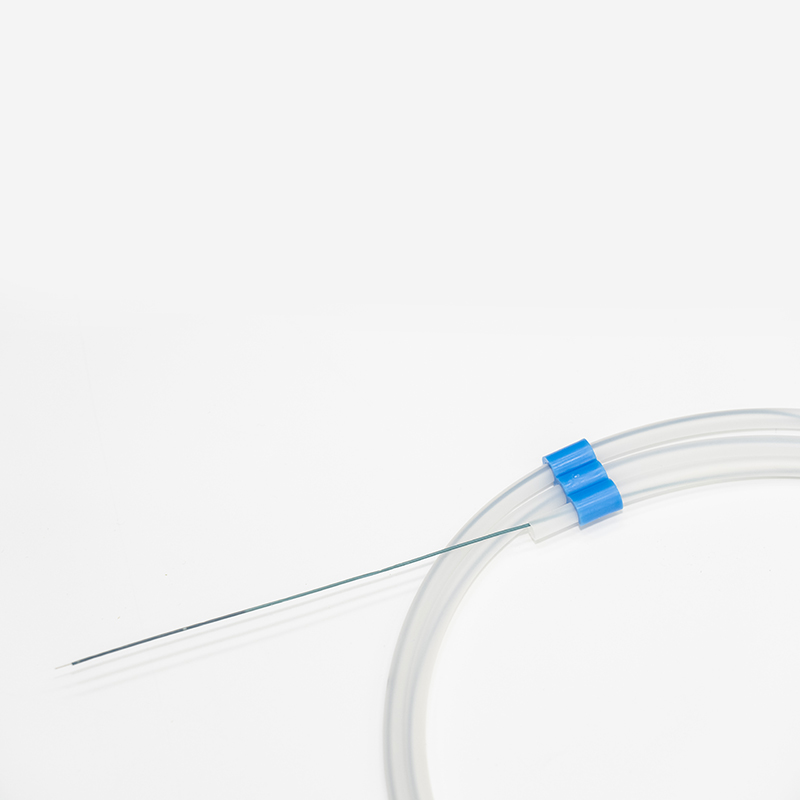 Micro Catheter with Customizable Stiffness and Rounded TipThis small reinforced catheter is designed for navigating tortuous vessels in minimally invasive procedures. Its customizable hardness and rounded head suit applications where low friction is needed across the entire length.View Product →
The performance requirement differs by application. A guiding catheter, for example, needs high pushability at the proximal end but low friction at the distal shaft where it tracks over a wire. A microcatheter, by contrast, needs uniformly low friction across its entire length because the final approach to the lesion is nearly always the most tortuous. For a detailed explanation of guiding catheter construction, see our technical article on guide catheters.
 Angiographic Catheter for Contrast Delivery and Pressure ResistanceThis catheter provides a channel for radiopaque agents during X-ray diagnostics. It features braided stainless steel construction, soft tip, and pressure resistance up to 1200 PSI, meeting varied performance demands.View Product →
Choosing a Hydrophilic Coating Partner
When evaluating an outsourcing partner for hydrophilic coating, four points matter:
- Substrate capability — does the partner extrude its own tubing, or must the substrate be sourced elsewhere?
- Process maturity — ask for CoF and adhesion data on the actual substrate, not just a datasheet.
- Cure compatibility — confirm the coating cures within the device's thermal budget.
- Sterilization validation — verify that EtO or gamma cycles do not degrade coating performance.
A partner with in-house extrusion, coating, and secondary processing can compress development timelines significantly. LINSTANT's OEM/ODM program provides that vertical integration, from polymer selection to final assembly. Discuss requirements early, especially if the device has unusual geometry or a fluoropolymer substrate.
About Ningbo LINSTANT Polymer Materials Co., Ltd.
Ningbo LINSTANT Polymer Materials Co., Ltd. was established in 2014 and has since grown into a national-level high-tech enterprise with over 500 professional staff members. The company is committed to transcending the role of a traditional component supplier, striving to become an integral part of its customers' products. From precise matching during the collaborative design phase to reliability assurance during manufacturing, LINSTANT deeply integrates into the core value chain of its customers' products, transforming catheter technology into a core competitive advantage for their products.
Through continuous technological innovation and stringent quality control, we are capable of providing medical device companies with safer, more precise, and more technologically advanced customised catheter system solutions.
Hydrophilic Coating FAQ
Q1. How long does hydrophilic coating last on a catheter?
A well-cured hydrophilic coating typically sustains lubricity for the duration of a procedure — usually 20 minutes to 4 hours of continuous wet contact. Durability depends on cure quality, substrate adhesion, and sterilization; after repeated cycling, friction gradually rises but commonly remains below 0.1 for many configurations.
Q2. What is the coefficient of friction of a hydrophilic coating?
Wet CoF is typically 0.02–0.05, compared to 0.3–0.5 for uncoated polymer tubing. The exact value depends on the substrate, coating thickness, cure conditions, and the test method used.
Q3. Can hydrophilic coating be applied to PTFE or PEEK tubing?
Yes, with proper surface preparation. PTFE requires chemical etching or plasma treatment before coating; PEEK can be coated after plasma activation or with a compatible primer. Confirming the substrate–coating interface early in a project avoids bonding failures later.
Q4. How is coating adhesion tested in medical device manufacturing?
Standard methods include the pinch test (repeatedly pinching the coated surface and inspecting for delamination), tape-pull adhesion testing, and scanning electron microscopy cross-sections after soak testing.
Q5. Does hydrophilic coating affect biocompatibility?
Coating ingredients are screened for cytocompatibility to ISO 10993-5; most commercial systems are non-cytotoxic. However, each device configuration should be tested with the final sterilization cycle, since EtO or gamma irradiation can alter cross-link density.
Q6. How does hydrophilic coating reduce friction in a catheter?
When wet, the coating's polymer matrix absorbs water and forms a slippery hydrated gel layer. Shear occurs between the device and tissue within this water-rich layer rather than at the solid–solid interface, which is why friction drops by more than 90 percent.


