


 English
  Français
  Español
  简体中文
简体中文
 简体中文
简体中文
A 2.7 Fr microcatheter can pass a straight-line tracking test and still kink the first time it meets a tortuous iliac artery. When that happens, the weak link is rarely the soft distal tip. It is the hypotube forming the proximal shaft, the component that decides how much push and torque actually reach the tip and how much is lost to ovalisation, buckling, or bond failure.
Hypotubes are also among the most mis-specified parts of a catheter bill of materials. Gauge numbers get mixed with millimetre callouts, wall thickness is quoted without a tolerance, and a cut pattern is chosen from a photograph instead of a stiffness target. The sections below cover what a hypotube is, how stainless steel, PEEK, and polyimide options compare, which dimensions carry the real procurement risk, and what to verify before releasing a purchase order.
Content
- 1 What Is a Hypotube?
- 2 Hypo Tube Materials: What Each Option Actually Buys You
- 3 From Tube to Shaft: How a Hypotube Becomes a Catheter
- 4 Dimensions and Tolerances That Carry Procurement Risk
- 5 Metal vs Polymer Hypotubes: Choosing by Function
- 6 What to Verify Before Releasing a Hypotube Order
- 7 About Ningbo LINSTANT Polymer Materials Co., Ltd.
- 8 Frequently Asked Questions About Hypotubes
- 8.1 Q1. What is a hypotube used for?
- 8.2 Q2. What is the difference between a hypotube and hypo tubing?
- 8.3 Q3. Can polymer tubing replace a stainless steel hypotube?
- 8.4 Q4. What is the smallest available hypo tube size?
- 8.5 Q5. Which tolerances matter most on a custom hypo tube?
- 8.6 Q6. Do you manufacture custom hypotubes and catheter shafts?
What Is a Hypotube?
A hypotube is a precision thin-wall tube with a small outside diameter relative to its length, used as the pushable, torque-transmitting shaft of a catheter, guidewire, needle, or delivery system. The word comes from hypodermic tubing, the drawn stainless steel stock behind needle manufacturing, and it now covers any shaft-grade tube doing the same mechanical job, including polymer and reinforced composite versions.
Two spellings appear on drawings and purchase orders. Hypo tubing usually means the mill product: straight lengths or coils of drawn tube in a nominal gauge. Hypotube usually means the finished component after cutting, laser profiling, deburring, and passivation. When a supplier quotes one and delivers the other, you either receive raw tube that nobody can bond or a finished shaft priced without its secondary operations.
| Gauge | Nominal OD | Nominal ID | Typical shaft role |
|---|---|---|---|
| 34G | 0.16 mm (0.0063 in) | 0.08 mm (0.0031 in) | Fine distal lumens, micro-wire passages |
| 32G | 0.23 mm (0.0090 in) | 0.10 mm (0.0041 in) | Neurovascular distal shafts |
| 30G | 0.30 mm (0.0120 in) | 0.15 mm (0.0060 in) | Microcatheter inner members |
| 27G | 0.41 mm (0.0163 in) | 0.21 mm (0.0083 in) | Small-bore delivery shafts |
| 25G | 0.51 mm (0.0203 in) | 0.26 mm (0.0103 in) | Microcatheter proximal shafts |
| 23G | 0.64 mm (0.0253 in) | 0.34 mm (0.0133 in) | Diagnostic catheter shafts |
| 20G | 0.90 mm (0.0354 in) | 0.58 mm (0.0230 in) | Guide catheter inner members |
| 18G | 1.27 mm (0.0500 in) | 0.84 mm (0.0330 in) | Trocar and access shafts |
Hypo Tube Materials: What Each Option Actually Buys You
Material selection is a stiffness decision first and a biocompatibility decision second. Every common hypotube material is already a medical-grade material with a long device history, so the real differentiator is mechanical behaviour and how many process steps the shaft will need afterwards.
Stainless steel 304 and 304V
Stainless steel remains the default. An elastic modulus near 193 GPa gives the highest push per unit of wall thickness, it is visible under fluoroscopy without additives, and the laser-cutting supply base is mature. The cost appears downstream: passivation, careful deburring to control particulate, and adhesive joints that tolerate very little surface contamination.
PEEK
PEEK sits in the middle at a flexural modulus near 3.8 GPa according to published material datasheets, roughly fifty times softer than stainless steel. That is a feature when the shaft must bend repeatedly without kinking, hold a formed curve, and stay compatible with MRI. PEEK is radiolucent unless compounded with barium sulfate or tungsten, bonds well to Pebax and nylon jackets, and can be flared, tipped, or machined after extrusion. For shafts where a soft proximal transition or magnetic compatibility matters, it removes a metal-to-polymer bonding step entirely. This overview of what PEEK tubing is used for in catheter shafts covers additional design detail.
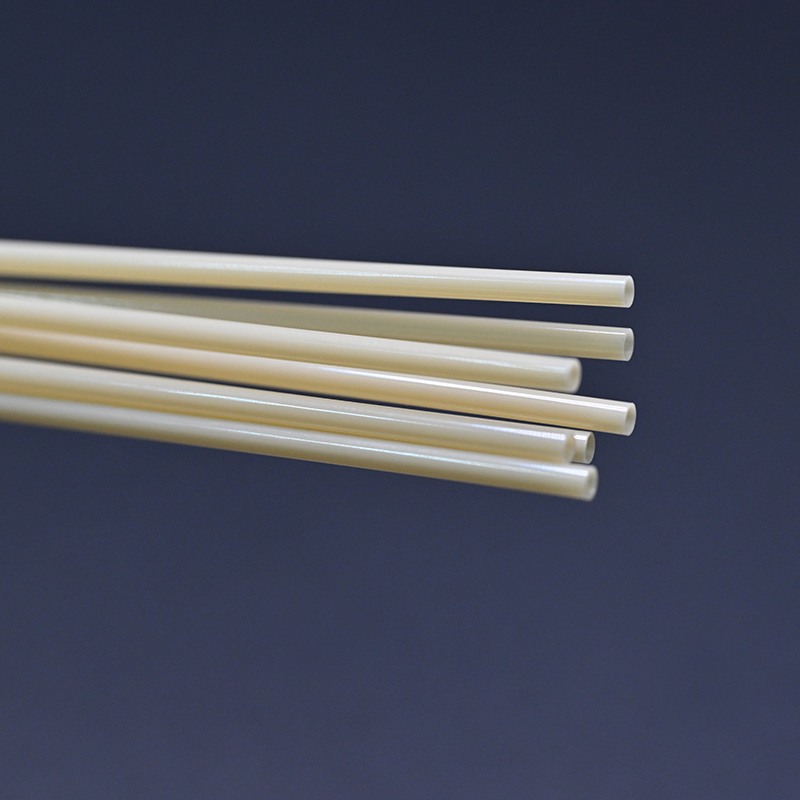 PEEK TubingPEEK material has high temperature tolerance and can operate stably in an environment up to 250 Celsius, while maintaining good mechanical properties, including high s...View Product →
Polyimide
Polyimide is the stiffest of the common polymer shaft materials, which makes it the usual reinforcement layer in microcatheters. It can be produced at wall thicknesses that would collapse in most other polymers, withstands steam and ethylene oxide sterilisation, and holds dimensions at temperatures that would deform Pebax. Its limits are brittleness in sharp bends and cost.
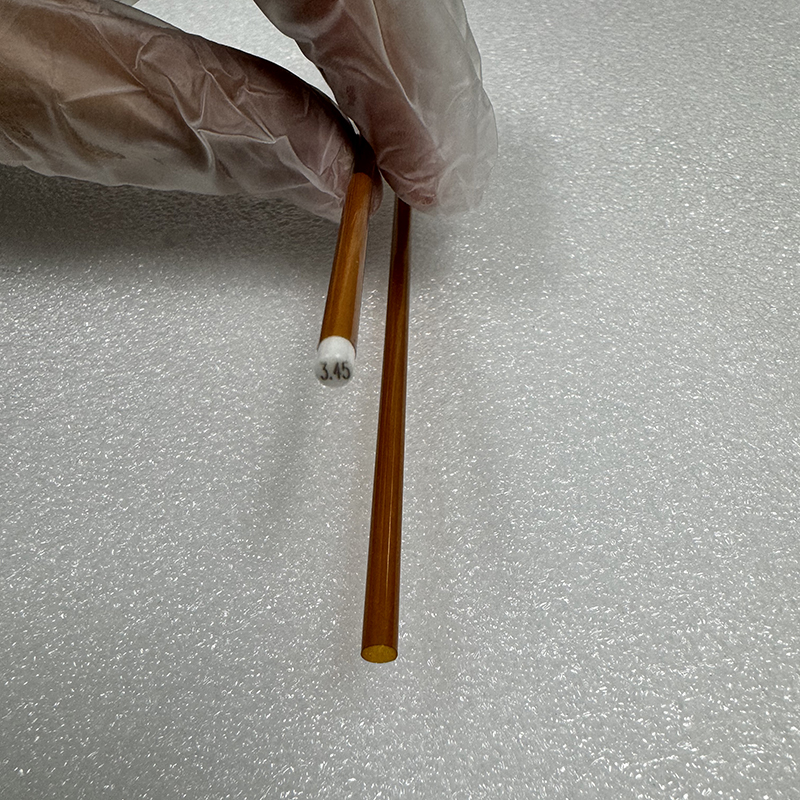 Medical Polyimide TubingMedical Polyimide Tubing exhibits good strength and wear resistance, maintaining its performance even at small dimensions. For medical surgical applications that deman...View Product →
Indicative flexural modulus values taken from published polymer datasheets. Stainless steel 304 is approximately 193 GPa and is left off the scale so the polymer differences stay readable.
From Tube to Shaft: How a Hypotube Becomes a Catheter
Few finished catheters are a single hypotube from hub to tip. The common architecture is a three-zone shaft: a stiff proximal section that carries push, a reinforced middle section that transfers torque, and a soft distal section that follows the guidewire without injuring the vessel wall.
Metal hypotubes are profiled by laser cutting rather than by changing material. Spiral cuts, interrupted cuts, and window patterns turn a rigid tube into a flexible segment, and the pitch of the cut sets the stiffness gradient. Polymer shafts reach the same result with different tools: a braid or coil layer, a variable-durometer jacket, or a multi-layer coextrusion. Braided construction delivers the highest burst and torque for a given wall thickness, which is why pressure-rated devices use it.
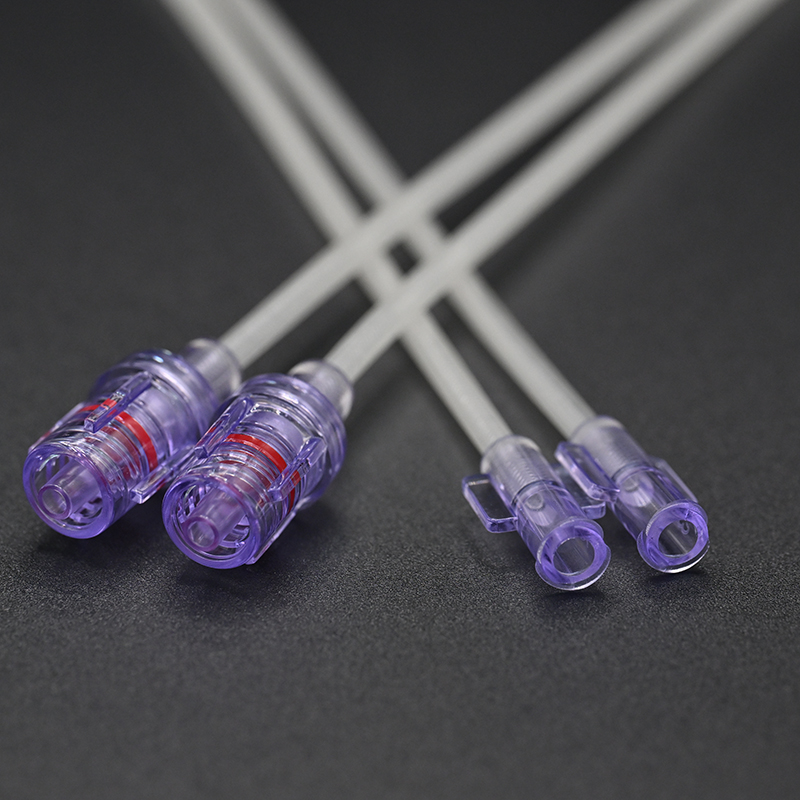 High Pressure Braided TubingHigh-Pressure Braided Tubing, or High-Pressure Monitoring Tubing, is used to inject contrast media and other medical solutions during PTCA, PCI procedures or angioplas...View Product →
Dimensions and Tolerances That Carry Procurement Risk
Most hypotube quality escapes are dimensional stack problems rather than material problems. Four numbers decide whether a shaft assembles and performs: outside diameter, inside diameter, wall uniformity, and cut-feature position.
| Parameter | Commonly specified | Why it matters |
|---|---|---|
| OD tolerance | ±0.013 mm (±0.0005 in) | Fit inside the guiding catheter or outer jacket; bond-line gap |
| ID tolerance | ±0.013 mm | Wire or device passage; flush and injection rates |
| Wall uniformity | 90% of nominal wall or better | Kink and burst performance under bending |
| Straightness (camber) | Typically 0.05 mm per 100 mm | Tip orientation, tracking, marker band alignment |
| Cut feature position | ±0.1 mm | Stiffness transition point and stress concentration |
| Edge condition | Burr-free, deburred, passivated | Particulate generation and guidewire abrasion |
| Surface finish | Ra 0.4 µm or better when electropolished | Friction, adhesion, thrombogenicity |
Three risks appear repeatedly. First, gauge and metric callouts get mixed: a 25G requirement and a 0.51 mm requirement are close but not identical, and the difference shows up at the bond joint. Second, tolerance is quoted without an inspection method, and ±0.013 mm means different things to a laser micrometer, an optical comparator, and a plug gauge. Third, camber and wall uniformity are left off the drawing even though they explain a disproportionate share of kinking and tip-orientation complaints.
Metal vs Polymer Hypotubes: Choosing by Function
If the requirement is maximum push in the smallest possible diameter, stainless steel still wins. If the shaft must bend repeatedly without kinking, remain usable in an MRI suite, avoid a metal-to-polymer bond, or transition into a soft tip without a joint, a polymer or reinforced composite hypotube is usually the better answer. The comparison below rates each material from 1 to 5 on the five criteria that drive most shaft design reviews.
- Push and torque: 304 stainless steel gives the most per unit of wall; PEEK and polyimide need a thicker wall or a braid layer to match it.
- Kink resistance: polymers win in tight bend radii; metal depends on the cut pattern and pitch.
- Radiopacity: stainless steel is visible by default; polymer shafts need a radiopaque compound or marker bands.
- Bonding: polymer shafts heat-bond or solvent-bond to jackets, while metal needs adhesive or welding plus surface preparation.
- Imaging compatibility: PEEK and polyimide work in MRI; stainless steel does not.
- Cost structure: metal has lower material cost and more secondary operations; polymer has higher material cost and fewer process steps.
What to Verify Before Releasing a Hypotube Order
Three checks catch most of the expensive surprises.
- Ask for the inspection method, not only the tolerance. The same ±0.013 mm callout behaves differently on a laser micrometer, an optical comparator, and a plug gauge, so name the method on the drawing.
- Confirm whether the quotation covers finished hypotubes or mill-length hypo tubing. Laser profiling, deburring, passivation, and inspection are separate line items and often separate capabilities.
- Request lot-level data on wall uniformity and camber, not just a certificate of conformance. These two variables account for a large share of kinking and tip-orientation complaints reported in the field.
For programs that need shaft development rather than catalogue tube, an OEM/ODM catheter shaft program can cover the whole chain, from extrusion and braiding through laser profiling, bonding, and inspection under one quality system. That removes the arguments that appear when the hypotube and the jacket come from different suppliers with different measurement conventions.
About Ningbo LINSTANT Polymer Materials Co., Ltd.
Ningbo LINSTANT Polymer Materials Co., Ltd. was established in 2014 and has since grown into a national-level high-tech enterprise with over 500 professional staff members. The company is committed to transcending the role of a traditional component supplier, striving to become an integral part of its customers' products. From precise matching during the collaborative design phase to reliability assurance during manufacturing, LINSTANT deeply integrates into the core value chain of its customers' products, transforming catheter technology into a core competitive advantage for their products.
Through continuous technological innovation and stringent quality control, we are capable of providing medical device companies with safer, more precise, and more technologically advanced customised catheter system solutions.
The company works from a GMP-compliant cleanroom facility of nearly 20,000 square metres and holds ISO 13485:2016 certification for medical device quality management. Production resources include imported extrusion lines with single, double, and triple-layer coextrusion capability, dedicated PEEK extrusion lines, injection moulding lines, and a large installed base of braiding, coiling, coating, welding, and forming equipment. The product range spans medical extruded tubing, reinforced tubing, balloon tubing, heat shrink tubing, fluoropolymer tubing, PEEK and polyimide components, micro catheters, guiding catheters, and angiography catheters, supported by secondary processes and surface treatment services.
Frequently Asked Questions About Hypotubes
Q1. What is a hypotube used for?
A hypotube forms the pushable shaft inside microcatheters, guide catheters, guidewires, needle assemblies, and stent delivery systems. It transmits push and torque from the hub to the distal tip while keeping the shaft thin enough to pass through narrow vessels.
Q2. What is the difference between a hypotube and hypo tubing?
Hypo tubing is the mill-length raw tube in a nominal gauge. A hypotube is the finished component after cutting, laser profiling, deburring, and passivation. Always confirm which one a quotation covers, because the price and the lead time are not the same.
Q3. Can polymer tubing replace a stainless steel hypotube?
In many shafts, yes. PEEK and polyimide hypotubes remove the metal-to-polymer bond, add MRI compatibility, and improve kink resistance. They give up axial stiffness, so longer or higher-pressure devices usually add a braid or coil reinforcement layer.
Q4. What is the smallest available hypo tube size?
Standard hypodermic gauges run to 34G, roughly 0.16 mm outside diameter and 0.08 mm inside diameter. Tighter bores exist as custom development items, but at that scale wall uniformity and handling become the limiting factors rather than the drawing process.
Q5. Which tolerances matter most on a custom hypo tube?
OD and ID tolerance, wall uniformity, and camber. Wall uniformity and straightness explain most kinking and tip-orientation complaints, yet they are the two values least often written on a drawing or confirmed in incoming inspection.
Q6. Do you manufacture custom hypotubes and catheter shafts?
Yes. LINSTANT extrudes and processes polymer tubing in PEEK, polyimide, PTFE, FEP, PFA, Pebax, and TPU, and builds reinforced shafts, braided tubing, and multi-layer catheter components under an ISO 13485:2016 quality system as an OEM/ODM partner.
Hypotube selection rewards early decisions. Fix the stiffness target, the wall uniformity limit, and the inspection method before tooling is cut, and the rest of the shaft follows from numbers rather than habit. Whether the final design ends up as laser-profiled stainless steel, a PEEK or polyimide shaft, or a braided composite, those same three decisions determine how it behaves inside the vessel.


