


 English
 Français
 Español
 简体中文
 简体中文
A spinal fusion cage, a microcatheter liner, a pump bearing and a semiconductor clamp ring can all be cut from the same beige polymer. That polymer is PEEK, and the short answer to "what is PEEK" is this: it is a semi-crystalline engineering thermoplastic in the polyaryletherketone family that keeps useful mechanical strength up to roughly 250 °C, shrugs off most chemicals, and can be extruded, moulded or machined. The longer answer is where projects succeed or fail, because grade selection, crystallinity and processing window decide whether the datasheet properties survive into the finished part.
Content
- 1 PEEK Chemistry in Plain Terms
- 2 The Property Profile Behind the Reputation
- 3 PEEK vs PTFE, Polyimide and PPS
- 4 From Resin to Finished Part
- 5 Where PEEK Earns Its Price in Medical Devices
- 6 Cost, Lead Time and Substitution Risk
- 7 Five Checks Before PEEK Goes on a Drawing
- 8 About Ningbo LINSTANT Polymer Materials Co., Ltd.
- 9 PEEK: Frequently Asked Questions
PEEK Chemistry in Plain Terms
Polyether ether ketone takes its name from its backbone: aromatic benzene rings joined by two ether linkages and one ketone linkage, repeating in a regular pattern. That regularity lets the chains pack into crystalline regions, typically 25 to 35 percent of the volume depending on how the part was cooled and annealed. The crystalline phase supplies stiffness, fatigue resistance and solvent resistance; the amorphous phase supplies toughness.
Two numbers frame everything else. The glass transition temperature sits at about 143 °C, where the amorphous phase begins to soften. The melting point is about 343 °C, which is why PEEK processing equipment has to run close to 380 °C. Between those two numbers, PEEK behaves like a stiff, creep-resistant solid rather than a rubbery plastic, which is precisely why it displaces metal in wear parts and implant components.
One regulatory detail is worth stating early: PEEK contains no fluorine. It is not a fluoropolymer and not a PFAS. At a time when per- and polyfluoroalkyl substances face heavy regulatory pressure, that single fact has moved more than one design team away from PTFE and toward PEEK.
The Property Profile Behind the Reputation
Published figures for unfilled PEEK cluster tightly across suppliers, which makes specification writing easier than it is for commodity plastics.
| Property | Typical value | What it means in design |
|---|---|---|
| Density | 1.30–1.32 g/cm³ | About one-sixth the weight of steel for the same volume |
| Glass transition (Tg) | ≈143 °C | Stiffness starts to fall above this point |
| Melting point (Tm) | ≈343 °C | Sets the melt processing window near 350–400 °C |
| Continuous service temperature | ≈250 °C in air | Long-term load-bearing limit, grade dependent |
| Tensile strength | 90–100 MPa | Comparable to some aluminium alloys per unit weight |
| Flexural modulus | 3.6–4.1 GPa | Closer to cortical bone than titanium is |
| Water absorption | ≈0.15% (24 h), ≈0.5% saturated | Dimensions shift slightly in vivo; allow for it |
| Flammability | UL 94 V-0 at 1.5 mm, low smoke | Useful in aircraft interiors and rail |
| Chemical resistance | Insoluble in common solvents | Attacked by concentrated sulfuric acid only |
Read these figures as a floor rather than a ceiling. A 30 percent glass-filled grade raises modulus and cuts thermal expansion; a carbon-filled grade adds wear resistance and electrical conductivity; barium sulfate additions make PEEK radiopaque when a clinician needs to see it under fluoroscopy.
PEEK vs PTFE, Polyimide and PPS
| Property | PEEK | PTFE | Polyimide | PPS |
|---|---|---|---|---|
| Continuous use (°C) | ≈250 | ≈260 | ≈300 | ≈220 |
| Tensile strength (MPa) | 90–100 | 20–30 | 90–110 | 75–85 |
| Wear resistance | Excellent | Poor | Good | Good |
| Melt processable | Yes | Difficult | No | Yes |
| Contains fluorine | No | Yes | No | No |
| Relative material cost | High | Medium | High | Medium |
Choose PTFE when friction and inertness dominate and mechanical load is light; its cold-flow under compression is the usual failure mode. Choose polyimide when temperature exceeds what PEEK can hold and the part is thin, such as a catheter reinforcement layer, but remember it is not melt processable. Choose PPS when cost drives the decision and chemical exposure stays moderate. Choose PEEK when one component must carry structural load, survive repeated sterilisation and remain radiolucent at the same time.
From Resin to Finished Part
PEEK absorbs enough moisture that it must be dried before melting, typically 150 °C for three hours or more in a desiccant dryer. Melt processing then runs between 350 and 400 °C with mould or die temperatures around 170–200 °C, and annealing above the glass transition builds the crystallinity that delivers the properties you specified. Skip the anneal and you get a part that looks right and performs below expectation.
Four routes cover most production: extrusion into rod, film and tubing; injection moulding of complex geometries; compression moulding of large slabs; and machining from stock shapes. Medical tubing usually comes from extrusion or machining, and the tolerance conversation matters early — medical drawings commonly call out inner diameter tolerances in the ±0.02 to ±0.05 mm range, which is achievable but must be inspected with the right method.
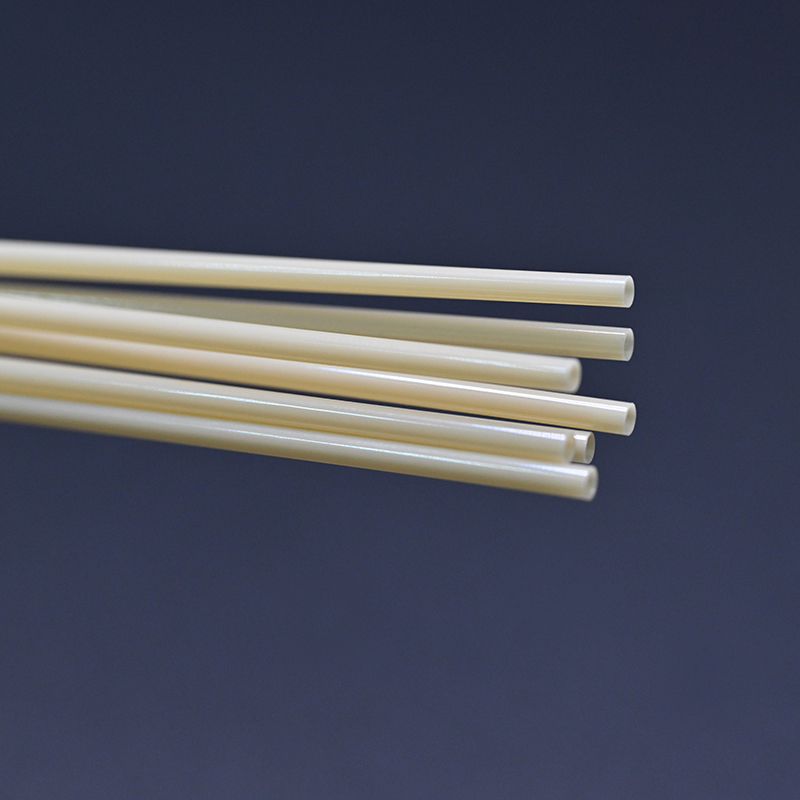 High-Precision PEEK Tubing for Medical ApplicationsPrecision PEEK tubing with inner diameters from 0.10 to 23.00 mm and tight OD tolerances for small sizes, suited to catheter and endoscopic components.View Product →
Heat shrink tubing is a separate but related tool: a PEEK or FEP sleeve shrinks over a catheter shaft during reflow, compressing layers together without adding a permanent outer wall.
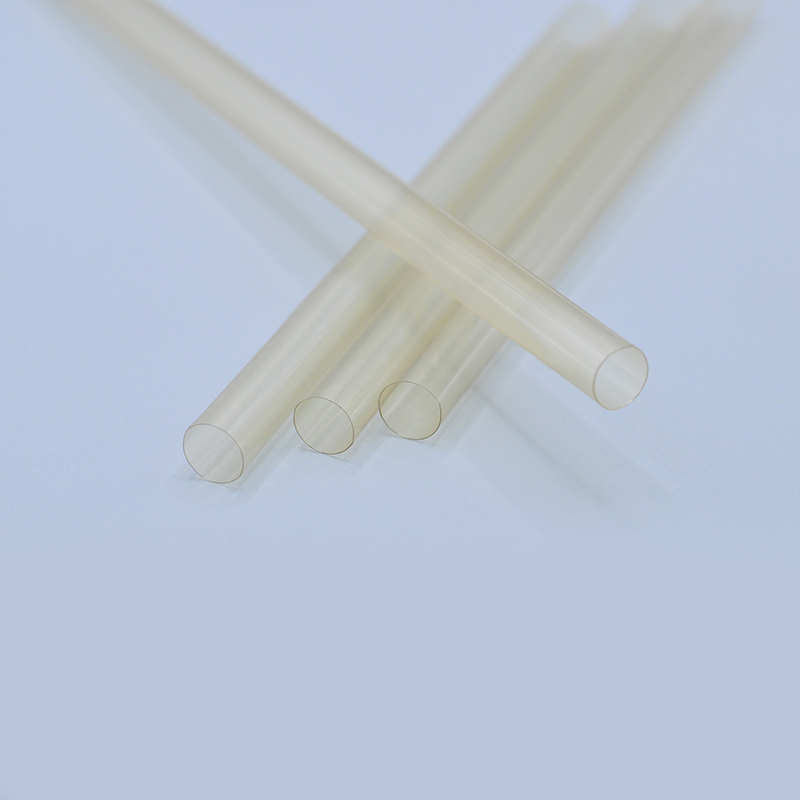 PEEK Heat Shrink Tubing for Sensitive ComponentsHeat-shrink PEEK sleeve with a 1.3/1.4 ratio and 170–190°C recovery temperature, suited to protecting sensitive components and critical connections in medical assemblies.View Product →
Where PEEK Earns Its Price in Medical Devices
Three properties carry most of the medical case. First, radiolucency: an unfilled PEEK component is invisible on X-ray and produces far less MRI artefact than titanium, so imaging around it stays clean. Second, modulus: at roughly 3.6 GPa, PEEK is much closer to cortical bone than metal alloys, which reduces stress shielding in spinal and trauma devices. Third, sterilisation stability: PEEK tolerates gamma, ethylene oxide and steam cycles without the yellowing or embrittlement that affects cheaper polymers.
In catheter work, PEEK appears as high-stiffness shaft segments, braid-bonded liners and hypotube alternatives where electrical or thermal insulation is needed. If you want a deeper look at how the material behaves in tube form, this overview of PEEK tubing covers wall thickness, straightness and tolerance practice.
Machined PEEK also serves the bench side of device development: trial implants, sterilisation fixtures, instrument handles and test rigs that must not scratch or contaminate what they hold.
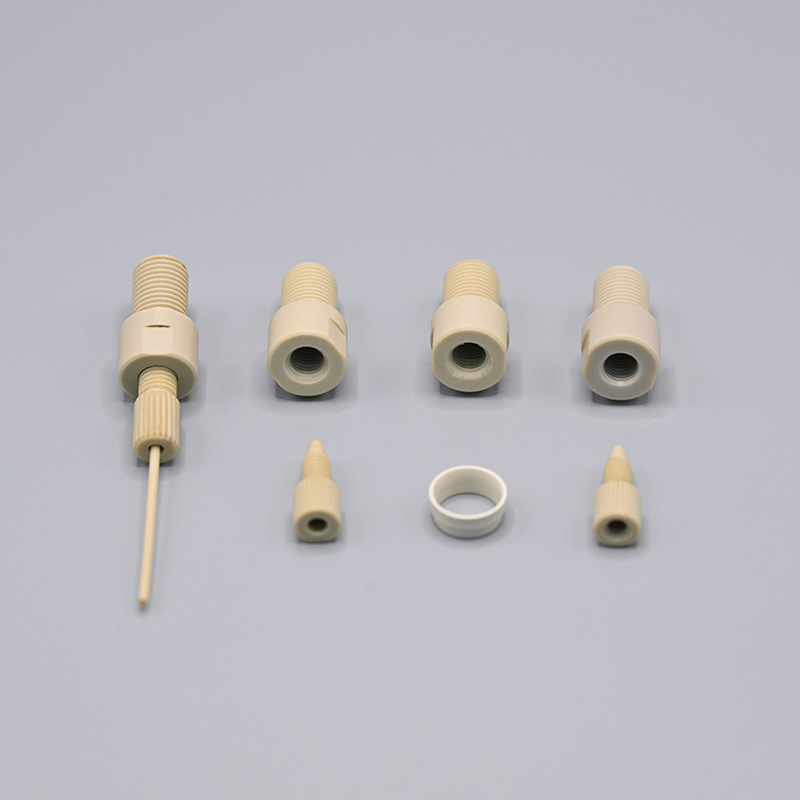 Precision-Machined PEEK Parts for Medical DevicesPrecision-machined PEEK parts for trial implants, sterilisation fixtures, instrument handles and medical device components, with high hardness, corrosion resistance and biocompatibility.View Product →
Cost, Lead Time and Substitution Risk
PEEK compound typically costs an order of magnitude more per kilogram than POM, PBT or nylon, and implant-grade lots with full traceability sit above that again. The price is rarely the deciding factor on a small component, but it dominates on a large housing. Two practical consequences follow. Design the wall thickness you actually need rather than the thickness you inherited from a metal part. And confirm the grade is available in the form you need before the design freeze, because specialty grades often carry longer lead times and higher minimum quantities than unfilled natural stock.
The quiet risk is substitution. PEEK looks similar to several cheaper beige polymers, and suppliers have been known to ship an unverified grade when demand spikes. Ask for lot traceability, a certificate of analysis against the exact grade, and confirmation of the resin source.
Five Checks Before PEEK Goes on a Drawing
- Confirm the real service temperature, including short excursions, rather than quoting the headline 250 °C figure.
- Decide whether the part needs annealing, and who is responsible for it.
- List every chemical the part will contact; PEEK is broad-spectrum resistant but not universal.
- State the inspection method alongside the tolerance, especially for tube inner diameters.
- Match the grade to the application: industrial, medical and implant grades are not interchangeable.
About Ningbo LINSTANT Polymer Materials Co., Ltd.
Ningbo LINSTANT Polymer Materials Co., Ltd. was established in 2014 and has since grown into a national-level high-tech enterprise with over 500 professional staff members. The company is committed to transcending the role of a traditional component supplier, striving to become an integral part of its customers' products. From precise matching during the collaborative design phase to reliability assurance during manufacturing, LINSTANT deeply integrates into the core value chain of its customers' products, transforming catheter technology into a core competitive advantage for their products.
Through continuous technological innovation and stringent quality control, we are capable of providing medical device companies with safer, more precise, and more technologically advanced customised catheter system solutions. Our PEEK extrusion, injection moulding and machining capacity sits alongside OEM and ODM services for device makers who need a manufacturing partner rather than a catalogue.
PEEK: Frequently Asked Questions
Seals, bearings, pump and valve components, aerospace brackets, semiconductor parts, spinal cages, dental frameworks and catheter tubing — anywhere heat, wear or chemical exposure rules out ordinary engineering plastics.
Around 250 °C continuously in air for unfilled grades, with a melting point near 343 °C. Short excursions above the continuous limit are possible but need application-specific validation.
Not in absolute terms — 100 MPa tensile strength is well below stainless steel. But per unit weight PEEK competes with aluminium, and it never corrodes or galling-welds.
No. PEEK contains no fluorine, so it falls outside fluoropolymer and PFAS restriction discussions. That is a major reason some teams switch from PTFE.
Medical and implant grades of PEEK are available and are commonly tested to ISO 10993 and USP Class VI. Industrial grades must never be substituted for them.
Compound prices typically run an order of magnitude above commodity engineering plastics, and implant grades cost more again. Tight tolerances and small volumes raise the part price further.


