


 English
 Français
 Español
 简体中文
 简体中文
A three-layer catheter shaft with a 0.05 mm PTFE liner, a 16-carrier braid and a 72D Pebax jacket can pass every bench test and still miss its launch date. The reason is rarely the design concept: the wall tolerance the design needs can only be held at an extrusion speed that halves throughput, and nobody discovers that until design transfer.
That is the practical core of medical device design for manufacturability. Most of the cost, yield and schedule risk in a catheter-based device is fixed by component geometry and material choice long before the finished device drawing is released. Design for manufacturability (DFM) is the engineering discipline of shaping a design so it can be produced consistently, at the required volume, on a known process, at a predictable cost. US Department of Defense guidance draws a useful line: producibility concerns the design itself, while manufacturability concerns the process and the factory floor. Both are far cheaper to fix on a screen than on a line.
Content
- 1 Why the shaft carries most of the DFM risk
- 2 A DFM checklist for catheter components
- 3 Tolerances: what to ask for, and what to stop asking for
- 4 Materials: the DFM trade-off that never reaches the drawing
- 5 Layer architecture: where the process window is set
- 6 Secondary operations: the cost centre nobody draws
- 7 How to run a DFM review with a tubing partner
- 8 About Ningbo LINSTANT Polymer Materials Co., Ltd.
- 9 Frequently asked questions
- 9.1 What is design for manufacturability in medical devices?
- 9.2 How early should a DFM review start on a catheter project?
- 9.3 What tolerances can medical tubing extrusion hold?
- 9.4 Which polymers are used for catheter shafts?
- 9.5 What is the difference between DFM and producibility?
- 9.6 How does braid reinforcement affect catheter manufacturing?
Why the shaft carries most of the DFM risk
In a catheter, the shaft is where tolerance, material and process collide. A micro-catheter specifying a 0.4 mm lumen at ±0.02 mm on the inner diameter is not requesting a dimension; it is requesting a particular extruder, screw, puller tension and operator. That tolerance consumes the assembly budget for the tip bond, the balloon neck and the hub joint before any of those parts have been designed.
One number explains why this belongs in concept review rather than verification. The cost of a change does not rise linearly with project maturity — it rises by orders of magnitude once tooling exists and validation has started. A wall thickness adjustment during concept is a meeting. The same adjustment after design transfer is a new die, a re-validation and a regulatory question.
Illustrative index based on the standard DFM observation that change cost grows steeply with program maturity; absolute multiples vary by device class.
A DFM checklist for catheter components
Before a die is ordered, six to eight questions usually decide whether the part will be cheap or expensive to make. The list below is the one worth walking through with a tubing supplier, in this order.
| Design decision | DFM question | Where it surfaces later |
|---|---|---|
| Wall thickness and concentricity | Can the wall be extruded within a workable band across the full length, including tapers? | Tip bond strength, burst pressure, kink resistance |
| Lumen count and geometry | Is every lumen necessary, and can the die fill them evenly? | Die cost, lumen roundness, guidewire friction |
| Polymer selection | Does the stiffness requirement really demand PEEK or polyimide, or would Pebax or TPU meet it at lower process risk? | Bonding method, sterilization compatibility, melt window |
| Reinforcement | Is the braid pic count and wire diameter performance-driven, or copied from a legacy design? | Braiding time per metre, OD growth, reflow window |
| Tolerance stack-up | Do tube tolerance, adhesive thickness and mating part tolerance add up to a functional joint? | Assembly yield, leak rate, inspection cost |
| Joints and transitions | Can the transition be made by reflow, adhesive or welding with available fixtures? | Fixture cost, cycle time, operator dependence |
| Secondary operations | Does the design assume tipping, flaring or skiving that needs custom tooling? | Tooling lead time, scrap rate, capacity |
Tolerances: what to ask for, and what to stop asking for
Extrusion tolerances are process outputs, not design wishes. For small-bore shafts, medical extruders commonly quote ID and OD tolerances in the tens of microns, with wall thickness often expressed as a percentage rather than an absolute value. The number that actually matters is the demonstrated capability for that specific line, material and cross-section — not a catalogue figure. Ask for capability data on your cross-section, not for the tightest number a sales sheet offers.
Concentricity beats absolute wall
A slightly thicker wall with good concentricity bonds and reflows more reliably than a thin wall that wanders.
Profile complexity has a price
D-shaped, crescent and multi-lumen profiles raise die complexity, inspection time and scrap, especially as lumen count climbs.
Tapers and durometer transitions
Each transition zone adds a control point. Three transitions on one shaft is a process, not a detail.
This is where component standardisation pays off. Where a device needs several functions along one shaft, a proven multilumen tubing profile is often easier to qualify than a bespoke cross-section designed from scratch.
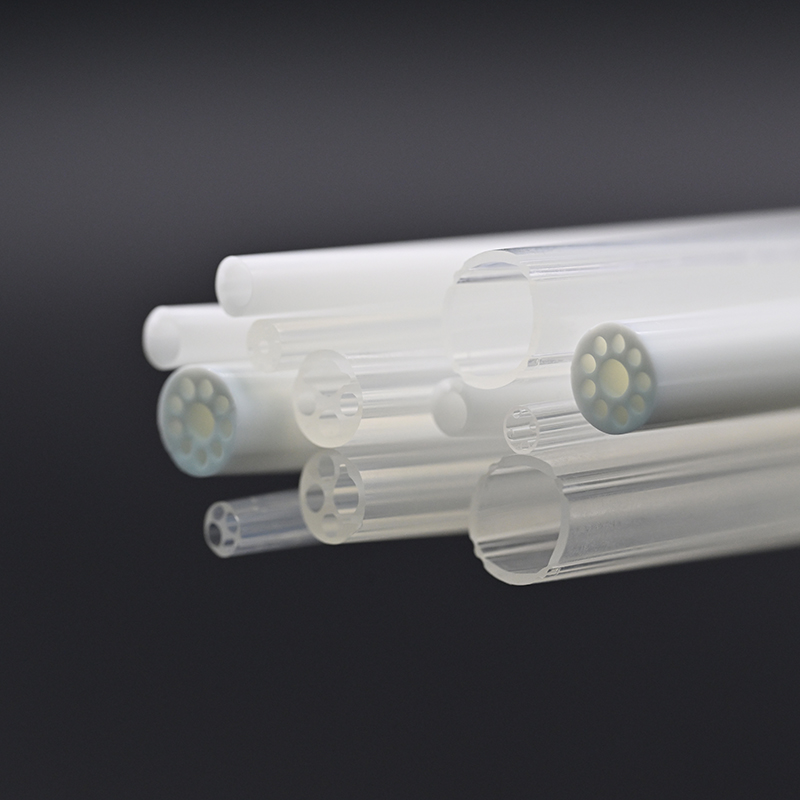 Multi-lumen TubingMulti-lumen tubing is designed with multiple channels within a single tube, featuring various external shapes and lumen configurations, to allow simultaneous access fo...View Product →
Materials: the DFM trade-off that never reaches the drawing
Material selection is usually argued on stiffness, radiopacity or lubricity. It should also be argued on process window, because the polymer decides the melt temperature, the drying regime, the bondable surface and the sterilization route.
Approximate published continuous-use values for orientation only; confirm against the resin supplier data sheet and your sterilization validation.
PEEK and polyimide buy heat resistance and stiffness, but they demand high melt temperatures, controlled drying and a bonding strategy — PEEK generally needs plasma or chemical surface preparation before adhesive will hold. PTFE is chemically inert and the most lubricious option, yet it cannot be melt-bonded without etching. Pebax and TPU bond easily and reflow predictably, but their softening points constrain sterilization choices and shelf life.
Scores reflect typical processing and use characteristics discussed in this article; they are not test data and should be re-scored against a specific device requirement.
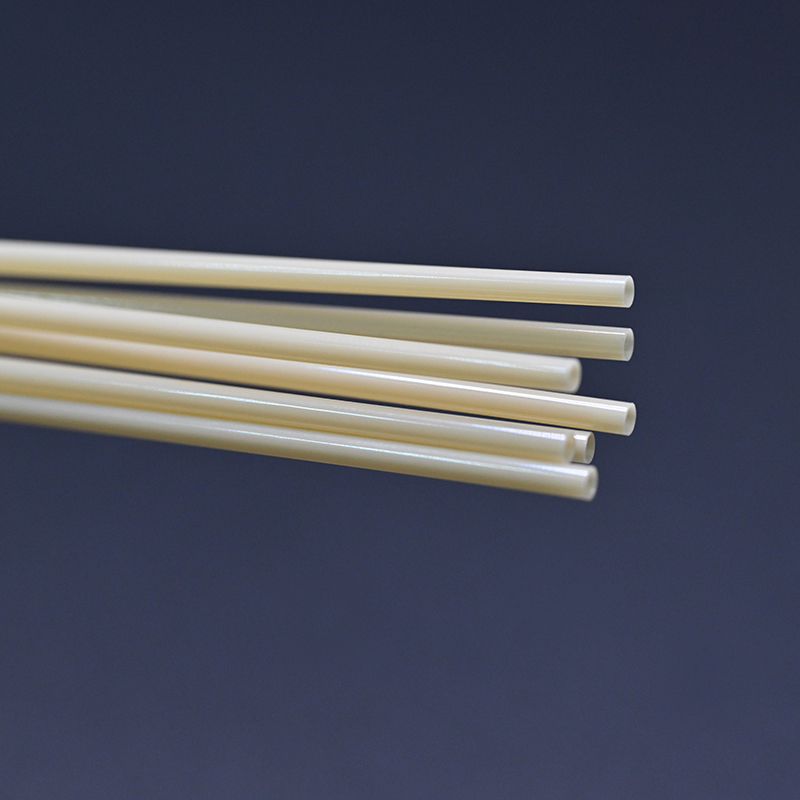 PEEK Tubing for High-Performance Medical ShaftsHigh-strength PEEK tubing with tight dimensional tolerances and repeated high-temperature sterilization suitability, relevant when evaluating shaft architectures and material choices.View Product →
Layer architecture: where the process window is set
Most shaft DFM problems are architectural rather than dimensional. A single-layer Pebax tube is a forgiving part. A three-layer construction with a PTFE liner, a braid and an outer jacket is a process, and every added layer introduces a variable that the design must tolerate.
Schematic representation of a reinforced shaft; dimensions are illustrative and not to scale.
- Liner wall thickness sets the minimum achievable ID and the surface that the tip bond must grip.
- Braid pic count and wire diameter set OD growth, braiding time and the reflow temperature the jacket will tolerate.
- Jacket durometer and thickness set the reflow window and the risk of liner collapse during heat shrink.
- Layer chemistry — or the presence of an etched or tie layer — decides whether the bond is mechanical or chemical, and whether it survives sterilization.
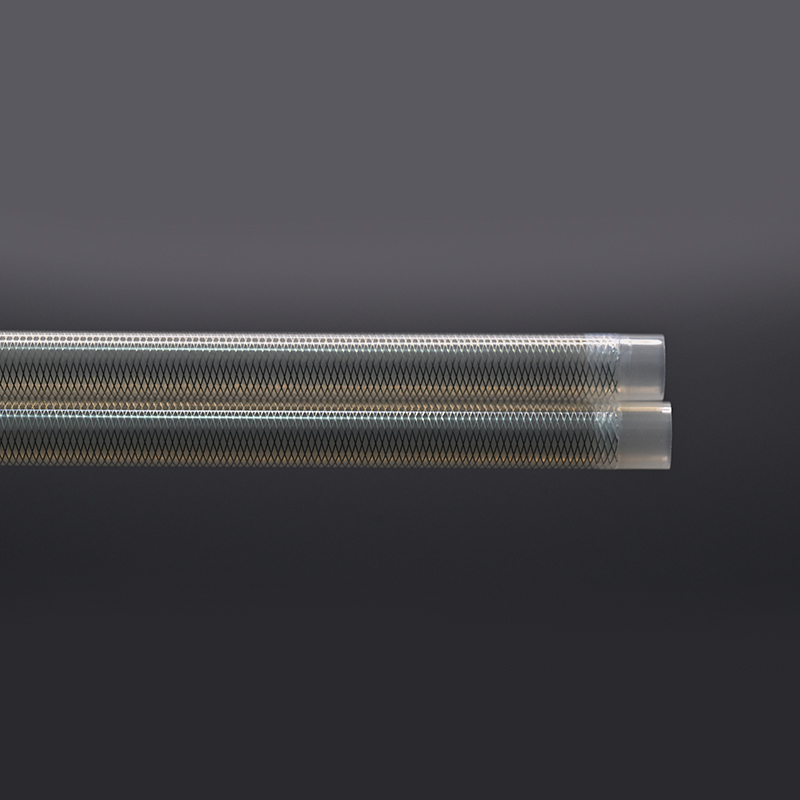 Braid Reinforced Tubing for Steerable Catheter ShaftsCo-extruded or reflowed reinforced tubing with customizable braid, liner and jacket materials, supporting torque control and burst pressure for complex catheter shafts.View Product →
Secondary operations: the cost centre nobody draws
Tip forming, flaring, skiving, heat-shrink reflow, window cutting and coating are where a clean design turns into a manufacturing system. Each adds a fixture, a setup and a scrap rate, and each is difficult to add late.
- Heat-shrink reflow depends on shrink ratio and recovery temperature matching the jacket polymer, not on the shrink tube alone.
- Soft tip forming needs a defined transition length; without it, the tip delaminates under repeated torquing.
- Skiving and window cutting usually demand a tighter depth tolerance than the tube itself, which changes how the shaft is dimensioned.
- Hydrophilic coating adhesion is a surface-preparation problem before it is a coating problem.
How to run a DFM review with a tubing partner
- Bring the function, not just the drawing: lumen size, pushability, burst pressure and bond method matter more than the nominal dimensions.
- Ask for capability data on your actual cross-section and material, including scrap and setup assumptions.
- Prototype in the production process — coextrusion, braiding and reflow — rather than in a laboratory surrogate.
- Limit critical-to-quality dimensions to three to five per component; more than that and the inspection plan stops being useful.
- Agree change control before tooling is released, so a wall adjustment does not restart the qualification cycle.
Suppliers that offer joint development rather than catalogue parts can usually shorten that loop considerably. LINSTANT's OEM/ODM service is built around exactly this kind of early-stage collaboration, from die design through secondary processing.
About Ningbo LINSTANT Polymer Materials Co., Ltd.
Ningbo LINSTANT Polymer Materials Co., Ltd. was established in 2014 and has since grown into a national-level high-tech enterprise with over 500 professional staff members. The company is committed to transcending the role of a traditional component supplier, striving to become an integral part of its customers' products. From precise matching during the collaborative design phase to reliability assurance during manufacturing, LINSTANT deeply integrates into the core value chain of its customers' products, transforming catheter technology into a core competitive advantage.
Through continuous technological innovation and stringent quality control, the company provides medical device manufacturers with safer, more precise and more technologically advanced customised catheter system solutions. Its capabilities span medical extruded tubing, reinforced and braided shafts, PEEK and polyimide components, balloon tubing, heat shrink tubing and secondary processing, supported by a GMP-compliant cleanroom facility and ISO 13485:2016 quality management.
Frequently asked questions
What is design for manufacturability in medical devices?
It is the practice of shaping the design so it can be produced consistently at the required volume and cost. In catheter devices it focuses on wall thickness, lumen geometry, material choice and joint design.
How early should a DFM review start on a catheter project?
At concept, before the bill of materials is frozen. Changes made then are nearly free; the same changes after design transfer require new tooling and re-validation.
What tolerances can medical tubing extrusion hold?
Small-bore shafts are commonly quoted within tens of microns on ID and OD, with wall thickness expressed as a percentage. The real number is the demonstrated capability for your material and cross-section.
Which polymers are used for catheter shafts?
PEEK, polyimide, PTFE, FEP, Pebax and TPU dominate. Each trades heat resistance, stiffness, lubricity and bondability differently, which is why material choice is a DFM decision.
What is the difference between DFM and producibility?
Producibility concerns the design itself; manufacturability concerns the process and factory-floor operations. DoD guidance treats them as related but distinct engineering activities.
How does braid reinforcement affect catheter manufacturing?
Braid pic count and wire diameter drive OD growth, braiding time and the reflow window. Over-specifying reinforcement adds cost without adding clinical benefit.


