


 English
  Français
  Español
  简体中文
简体中文
 简体中文
简体中文
A 0.03 mm swing in wall thickness looks harmless on a drawing. On the bench it turns into a kink at the aortic arch, a balloon that will not track, or a hemostasis valve that drips. In our experience, most catheter performance complaints trace back to the extrusion line rather than to the catheter design.
The short answer: catheter extrusion defines the tolerance band you can hold, the bond strength available downstream, and how repeatable the finished device will be at scale. Get the extrusion window right and every later step becomes easier. Get it wrong and no amount of tipping, bonding or assembly work will rescue the device.
This guide walks through what extrusion actually controls, the process variables that matter, the polymers that behave differently on the same screw, the defects that show up first, and the quality checks that keep a validated process from drifting.
Content
- 1 What Catheter Extrusion Controls Before Anything Else
- 2 The Extrusion Line, Step by Step
- 3 Material Choice Rewrites the Temperature Window
- 4 Where Extrusion Defects Actually Come From
- 5 Tolerances, In-Line Gauging and Quality Control
- 6 From Extruded Tube to Finished Catheter
- 7 Choosing an Extrusion Partner
- 8 Frequently Asked Questions
What Catheter Extrusion Controls Before Anything Else
Extrusion is the step that fixes geometry every other process assumes. If a shaft comes off the line with a 12 percent wall variation, the braiding, reflow and tip-forming stages inherit that variation and amplify it. That is why experienced teams lock the extrusion window before they finalise the catheter design, not after.
Five outputs matter most on a typical interventional shaft: outer diameter, wall thickness and concentricity, ovality, inner-lumen surface finish, and dimensional stability across the whole spool.
| Parameter | Typical target | Why it matters downstream |
|---|---|---|
| Outer diameter | +/-0.02 to +/-0.05 mm on 1-3 mm tubing | French size, sheath fit, catheter exchange |
| Wall thickness / concentricity | Within 10% of nominal wall | Kink resistance, burst pressure, reflow consistency |
| Ovality | Low single-digit percentage | Valve sealing, tip forming, leak-free connections |
| Inner surface roughness | Sub-micron Ra on the lumen | Trackability, flush volume, coating adhesion |
| Spool-to-spool stability | Same band across the full length | Assembly yield and automated feeding |
Thin-wall shafts are where these numbers get hard. When the wall drops toward 0.05 mm, the melt has less room to relax and the draw-down window narrows sharply.
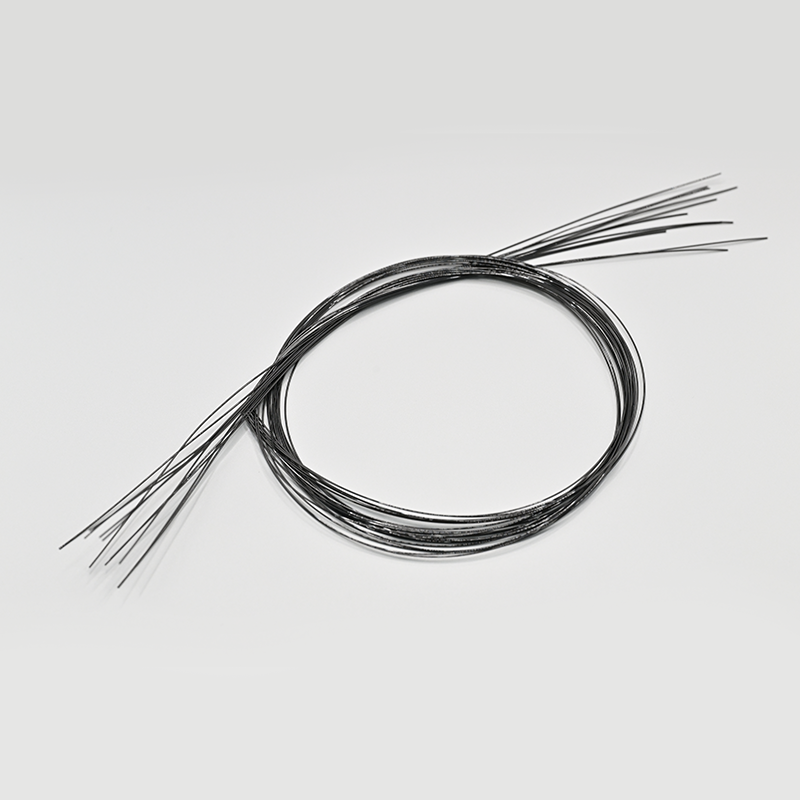 Ultra Thin Wall Medical Tubing for Precision Fluid TransportUltra-thin extruded medical tubing supports precise inner diameters and material options such as TPU, Pebax, and PEEK for minimally invasive and fluid-channel uses.View Product →
The Extrusion Line, Step by Step
Most catheter tubing is produced on single-screw or dual-screw lines with a crosshead die and vacuum sizing. The sequence below is standard, but each step carries a control point that decides final tolerance.
- Drying and material handling. Hygroscopic resins such as polyamide-based block copolymers and TPU absorb moisture. Undried pellets produce bubbles, gel and surface streaks that only appear hours into a production run.
- Feeding and melting. Screw geometry and compression ratio determine how gently the polymer melts. Shear-sensitive resins need a gradual compression zone to avoid degradation.
- Metering and pressure stability. Melt pressure variation translates almost directly into diameter variation. A gear pump or a well-tuned metering zone flattens that curve.
- Crosshead die and draw-down. The die sets the shape; the draw-down ratio between die exit and final tube size sets the wall. Small changes here move wall thickness quickly.
- Cooling and sizing. Vacuum sizing tanks and water temperature control determine roundness and surface quality. Cooling too fast freezes stress into the wall.
- Take-off, gauging and winding. Constant tension prevents stretch marks and ovality; in-line gauging catches drift before a full spool is wasted.
An isometric view of a tubing line: polymer enters at the extruder, the melt is shaped in a crosshead die, sized under vacuum, measured by a laser gauge, and pulled away at constant tension. Each block is a control point, not just a machine.
Material Choice Rewrites the Temperature Window
The same screw and die behave completely differently with a new resin. Polyamide block copolymers such as Pebax and TPU process in a moderate barrel range, while PEEK and fluoropolymers demand dedicated lines, corrosion-resistant tooling and longer purge cycles. Switching a line from PEEK back to a low-temperature elastomer is rarely economic, which is why specialists keep separate extrusion capacity for high-temperature polymers.
Beyond temperature, the property profile of each polymer decides which shaft architecture makes sense. A stiff, heat-resistant material is not automatically the best choice for a trackable shaft.
PEEK and polyimide score high on stiffness and heat resistance; Pebax and TPU score high on flexibility. Most modern shafts mix both worlds through multi-layer coextrusion, where a soft outer layer carries the hydrophilic coating and a rigid inner layer carries the lumen. For a closer look at how that technology is applied in practice, see this overview of multilayer catheter coextrusion.
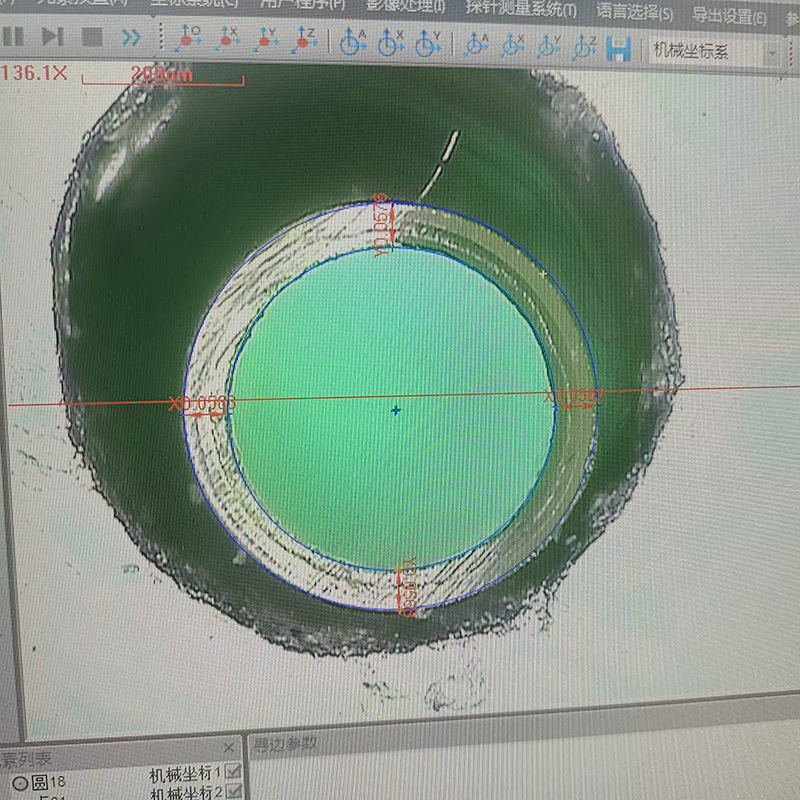 Medical Multi-Layer Tubing for Catheters and Drug DeliveryMulti-layer extruded tubing combines inner biocompatibility with outer strength or protection, supporting catheters, infusion, drainage, and drug delivery systems with tight tolerances.View Product →
Where Extrusion Defects Actually Come From
Defects rarely appear randomly. In production troubleshooting, the same five root causes account for most rejected spools.
Illustrative distribution based on typical troubleshooting patterns in medical tubing production, not a measured industry statistic.
- Diameter drift usually points to melt pressure instability or a take-off speed mismatch.
- Gels and black specks indicate incomplete purging, degraded resin in dead zones, or moisture.
- Wall eccentricity often comes from die centring or an unbalanced vacuum in the sizing sleeve.
- Melt fracture and roughness appear when output rate exceeds what the die geometry can handle at that temperature.
- Ovality on the spool is a tension and winding problem rather than an extrusion problem.
Tolerances, In-Line Gauging and Quality Control
A validated process is not a stable process forever. Vacuum settings creep, dies wear, and a new resin lot can shift melt viscosity. Continuous measurement is the only practical defence.
Practical control measures on a catheter extrusion line include:
- Laser or ultrasonic gauging at fixed intervals, logged against spool position.
- Statistical process control on OD, wall and ovality, with reaction rules rather than after-the-fact inspection.
- Installation, operational and performance qualification on every new die and resin combination.
- Full lot traceability from pellet batch to finished spool, under a quality system such as ISO 13485.
- Documented change control for any adjustment that touches the validated window.
From Extruded Tube to Finished Catheter
Extrusion is usually the first of several operations. Secondary processes such as tipping, flaring, hole punching, reflow bonding, braiding and heat-shrink lamination are what turn a spool of tubing into a working shaft. These steps depend heavily on what happened upstream: a lumen that is slightly out of round will not seal reliably against a hemostasis valve, and a wall with frozen-in stress will distort during reflow.
Complex lumen layouts place the highest demand on the extrusion step. Multilumen profiles with two, three or more channels require balanced flow through the die so that every lumen keeps its shape and cross-section along the full length.
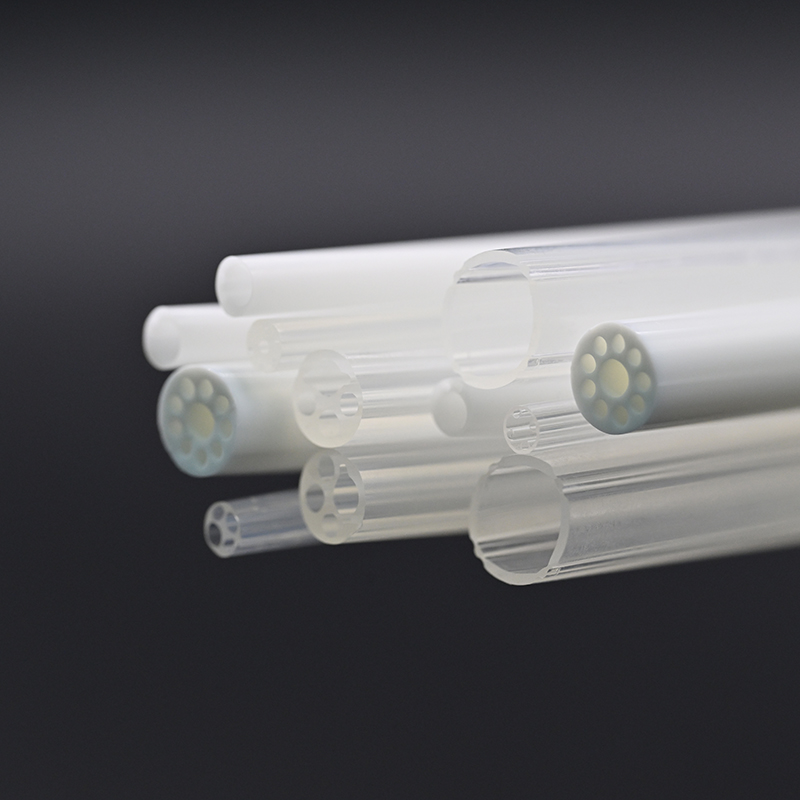 Multi-Lumen Medical Tubing for Complex Catheter DesignsExtruded tubing with customizable multiple channels enables simultaneous access for guidewires, medications, and gases in coronary, dialysis, endoscopy, and neurovascular catheter applications.View Product →
Choosing an Extrusion Partner
For device manufacturers, the extrusion supplier is effectively part of the design team. The difference between a component vendor and a development partner shows up in how early they are involved and how much of the process window they can document for you.
Ningbo LINSTANT Polymer Materials Co., Ltd. was established in 2014 and has since grown into a national-level high-tech enterprise with over 500 professional staff members. The company is committed to transcending the role of a traditional component supplier, striving to become an integral part of its customers' products. From precise matching during the collaborative design phase to reliability assurance during manufacturing, LINSTANT deeply integrates into the core value chain of its customers' products, transforming catheter technology into a core competitive advantage for their products.
Through continuous technological innovation and stringent quality control, we are capable of providing medical device companies with safer, more precise, and more technologically advanced customised catheter system solutions.
The production base covers close to 20,000 square metres of GMP-compliant cleanroom space, with 15 imported extrusion lines supporting single, double and triple-layer coextrusion, eight dedicated PEEK lines, two injection moulding lines, and around 100 braiding, coiling and coating units. Material coverage spans PEEK, polyimide, PTFE, ePTFE, FEP, PFA, ETFE, TPU, Pebax, PET and PVDF, and the product range extends from base tubing through reinforced shafts and balloon tubing to micro catheters and guiding catheters. Quality management is certified to ISO 13485:2016.
For teams that need design support rather than off-the-shelf tubing, the OEM and ODM service covers joint development, tooling, process validation and serial production.
Frequently Asked Questions
Q1. What is catheter extrusion?
It is the melt process that shapes polymer pellets into continuous catheter tubing with a defined inner diameter, outer diameter and wall. It sets the geometry that all later assembly steps rely on.
Q2. What tolerance can catheter extrusion hold?
Well-controlled lines typically hold outer diameter within +/-0.02 to +/-0.05 mm and wall within about 10 percent of nominal, depending on resin, wall thickness and tubing size.
Q3. Which polymers are used for catheter tubing extrusion?
Pebax, TPU, PVDF, PET, polyimide, PEEK, PTFE, FEP, PFA and ETFE are common. Material choice drives the temperature window, the stiffness of the shaft and the coating strategy.
Q4. What is the difference between single-lumen and multilumen extrusion?
Single-lumen tubing has one channel. Multilumen tubing packs two or more channels into one profile, which requires balanced die flow so each lumen keeps its cross-section along the length.
Q5. How do you prevent kinking in extruded catheter tubing?
Concentric walls, consistent wall thickness, the right durometer or a braided reinforcement layer, and a controlled reflow process all raise kink resistance.
Q6. Can extruded tubing be supplied as part of a full OEM catheter assembly?
Yes. Extrusion suppliers with secondary processing capability can deliver tipped, bonded, braided or coated shafts, or support full custom catheter development from design phase to serial production.


